If you're reading this right now, I already know something about you.
You're tired.
Not the kind of tired that sleep can fix… but the kind of tired that lives inside your chest. The kind that follows you to work, to church, to family gatherings, to bed.
You're the woman who shows up for everybody.
You answer his calls on the first ring. You cook even when you're exhausted. You send "good morning my love" before your eyes are fully open. You remember his mother's birthday, his cousin's wedding, his best friend's baby shower.
And somehow… you're still the one paying your own data subscription.
You're still the one taking taxis when his car is right there. You're still the one buying your own perfume, paying your own rent, sorting your own light bills, replacing your own phone screen when it cracks.
You smile in pictures. You post the soft-life captions. But late at night, when the lights go off and it's just you and the ceiling fan, the questions come crawling back…
"Why am I always the one doing everything?"
"Why does it feel like I'm the man in this relationship?"
"When is it my turn to be poured into?"
You've watched other women get flowers, get sent money "just because," get surprise weekend trips, get bills paid before they even ask. And you've wondered… what do they have that I don't?
You're not lazy. You're not greedy. You're not "doing too much." You just want to be loved the way you love. You want to feel held. You want to stop feeling like the strong one all the time.
And the worst part? When you try to bring it up… he says you're "becoming materialistic." He says "money isn't everything." He says "I thought we were building together."
Meanwhile, his other friends' girlfriends are flying out for birthdays.
If any of this sounds like your life right now… drop everything you are doing now and listen to every word I'm about to say.
Because I'm about to share with you a simple positioning method that changed everything for me.
This is not new wisdom.
Our grandmothers knew it. Our great-grandmothers practiced it. The women who ran entire households in Onitsha, in Aba, in Kano, in Ibadan… without raising their voices… they all understood this same principle.
It was quietly passed from mother to daughter, from aunty to niece, on quiet evenings while pounding yam, while plaiting hair, while walking back from the market.
Somewhere along the way, our generation lost it. We were told to "be independent," to "not depend on any man," to "shoulder everything yourself so nobody can use you." And so we did. We carried, and carried, and carried… until our shoulders started to break.
Hi, my name is Sophia Jonathan.
And the first thing you should know about me is that I am NOT a relationship coach. I am NOT a therapist. I don't have a fancy certificate hanging on a wall somewhere. I'm just a regular Nigerian woman who saw hell for a long time… and finally found her way out.
Let me tell you how my own eyes opened.
It started about three years ago, when I moved in with my then-partner in Lekki. We had been dating almost two years. He was charming, funny, a "vision-board man" — always painting big pictures of our future.
I believed him so much I sold my small apartment in Yaba and moved my whole life into his place.
At first, things were sweet. He cooked for me once. He took me out for my birthday. Then the slow drift began.
"Babe, can you handle the data this month?" turned into "can you cover the light bill, I'll refund you next week." The refund never came. "Next week" became "next month." "Next month" became silence.
Within six months I was paying for groceries, the cleaning lady, our weekend outings. I was even giving him "small change" when he was going out with his guys, because I didn't want him to be embarrassed.
Meanwhile, I watched my account balance shrink. I watched my own dreams quietly die.
The breaking point came on a Saturday.
I was scrolling through his phone — don't judge me, every Nigerian woman has done it once — and I saw a chat with one of his close guys. He was literally bragging: "this babe is paying for everything, I'm just chilling, you know how I do."
I cannot describe what happened in my chest that day. I sat on the bathroom floor and cried. Quietly. So he wouldn't hear me from the parlour.
Two days later I called my godmother in Enugu. The only person I trust with my real, raw truth. I told her everything. She listened without interrupting. And when I finished, she said something I will never forget:
"My daughter, a man will only do for you what you have positioned him to do. The problem is not him. The problem is the position you took from day one."
I didn't fully understand what she meant. But that one sentence stayed in my head for weeks.
So I did what every woman in 2024 does — I went online looking for answers.
I tried everything.
I tried the "give him space" YouTube advice. Went silent for two weeks. He didn't notice — he just enjoyed the peace.
I tried "communicating my needs clearly." Sat him down, made a list, cried, explained. He promised. He changed for four days. Then back to default.
I tried being colder, more distant. He just chased somebody else.
I tried "matching his energy." We both became flat. The relationship felt like a roommate situation.
I tried being "more feminine" the way Instagram aunties preach. Long lashes, soft voice, agreeing with everything. He took it as weakness and pushed harder.
I even went to a prayer house in Mushin. The prophet collected ₦15,000 and told me to bathe with a candle. I won't even tell you what happened with the candle.
Nothing worked. Nothing.
And then came the day everything changed.
It was a naming ceremony in Ikeja GRA. Nothing special — just food, jollof rice, and people catching up. I almost didn't go. I was too tired. Too embarrassed about the state of my life.
But I dragged myself there. And there was one woman I couldn't ignore.
Her name was Aunty Ngozi. About 52. Married 25 years to a quiet, well-respected businessman. She wasn't loud. She wasn't trying to impress anyone. But somehow, everything around her felt calm.
I watched her husband refill her drink without her asking. Stand up to adjust the AC the moment she mentioned feeling warm. She didn't ask for anything. He just… provided.
I cornered her by the dessert table. Gave her the short version of my situation. Asked her plainly: "Aunty, please. What is your secret?"
She laughed softly. Then she sat me down on one of the white plastic chairs, took my hand, and said:
"Sophia, you've been doing too much. The space he should be filling… you've already filled it. A man cannot rise to provide for a woman who has positioned herself as the provider. Stop. Say less. Position better. Then let him step up."
Then she told me something that hit even harder:
"Men don't respond to pressure. They respond to three things — emotional connection, appreciation, and the feeling of being needed as a provider. Trigger those three things correctly, and provision becomes natural. He gives without you begging. Because his ego will demand it."
I stared at her. Because honestly? It sounded too simple. I had spent thousands on books, courses, candles, and YouTube subscriptions… and this 52-year-old aunty was telling me the answer in three sentences over jollof rice?
I almost dismissed it. But something in me said: "Sophia, what do you have to lose? Try it for 30 days."
So I went home and started.
The first three days felt awkward. I was so used to over-functioning that stopping felt like withdrawal. By day five, I was doubting. "This isn't working. He hasn't even noticed."
But then, on day seven, something shifted.
He came home from work, looked at me sitting quietly on the couch, and asked: "Babe, you've been quiet lately. Are you okay? Do you need anything?"
I almost choked on my zobo. For the first time in eight months, this man was asking what I needed.
I didn't dump a list on him. I just smiled and said: "I've been thinking about getting my hair done this weekend, but I haven't decided yet."
The next morning, ₦45,000 landed in my account with a message: "For your hair, babe. Do something nice for yourself."
I sat on the bed and cried. Different tears this time.
That was just the beginning. Within two weeks, he was more attentive. More present. Asking about my day before I asked about his. Ordering food for me without me hinting. Paying two of my bills without me mentioning them.
Then one evening — and I'll never forget this — he was lying with his head on my lap, looked up at me, and said:
"You've changed… I don't know what it is, but it makes me want to do more for you."
That was the moment it clicked.
It was never about doing more. It was about positioning differently.
A month later I went back to Aunty Ngozi, properly grateful this time. She introduced me to two other women using the same method. Chinwe, whose husband used to "forget" her housekeeping money, now gets a monthly allowance every 1st, untouched. Adaeze, whose boyfriend bought her a car within four months of applying the method.
I was floored. This was real. This was working. And it wasn't juju, it wasn't manipulation, it wasn't begging — it was just positioning.
After my own life shifted, I started quietly sharing the method with my close friends. Then their friends started reaching out. Then strangers on Instagram started DMing me after I posted a small "soft life" reel.
It got to a point where I was answering the same questions over and over. "Sophia, how exactly did you start?" "Sophia, what do I say first?" "Sophia, what if he gets defensive?"
I couldn't keep up.
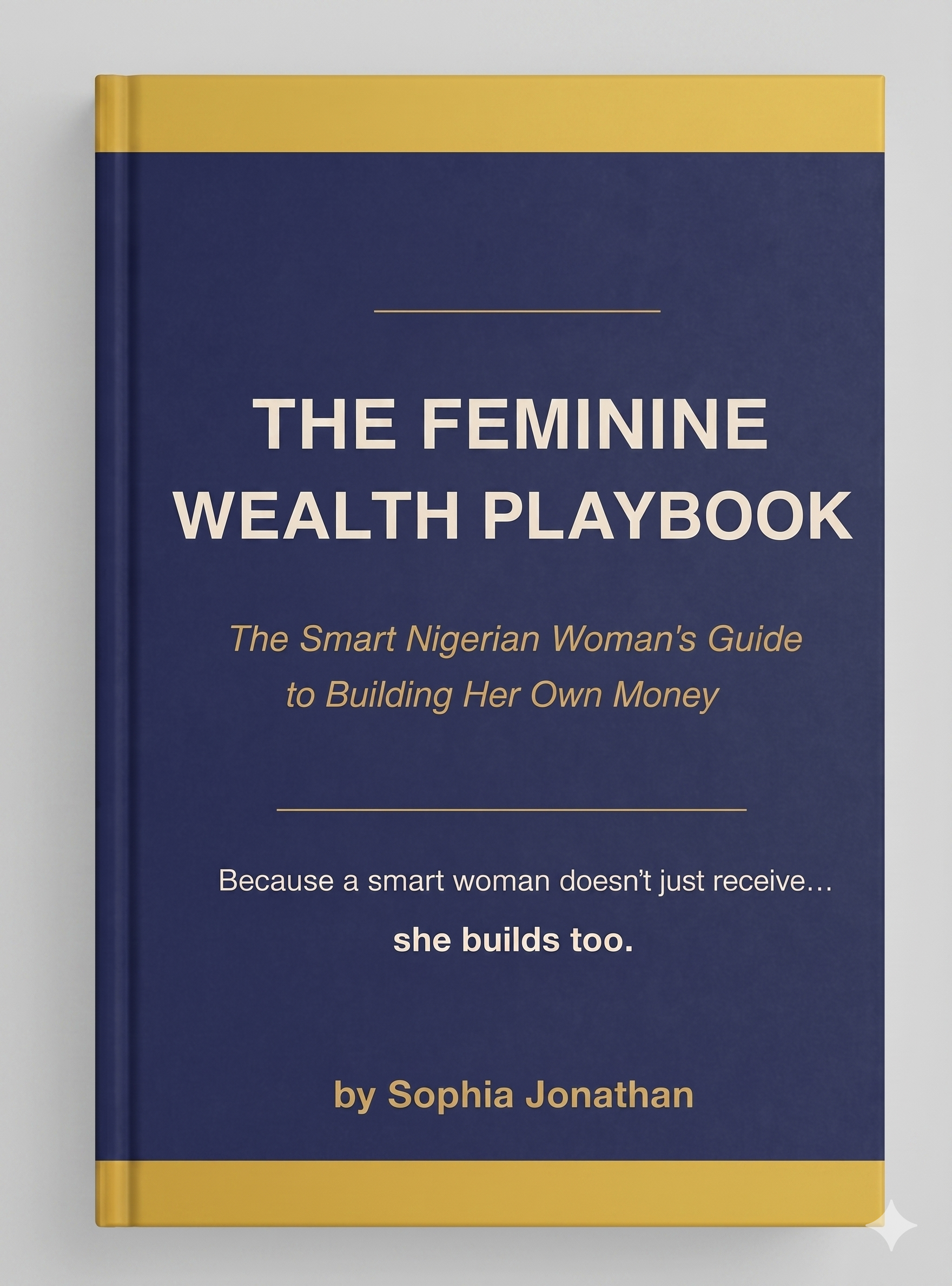
So I sat down for several weeks, and I packaged everything — the full method, the exact words, the conversations, the timing, what to do, what to never do, the mindset shifts, the practical scripts — into one simple, easy-to-read guide.
So that any Nigerian woman, no matter where she is, can read it tonight, start applying it tomorrow, and start seeing changes within her first week.
Introducing…
And the best part? You don't need to nag, you don't need to manipulate, and you don't need to play games. It's the same simple method that worked for me, and has now worked for over 2,400+ Nigerian women I've quietly shared it with — from Lagos to Abuja to Port Harcourt to Enugu and beyond.





Share Your Experience